
Challenges and Community
Each person in our coalition has a story that inspires and shapes their work and our work as a larger coalition. This month’s blog is lengthier, a deeply felt personal story. Keep in mind the “Patchwork of Parenting” event in May 2026,another place for sharing stories. Thank you to Abby Hall Luca for sharing so much with us in this story of her family’s beginning.
From Abby Hall Luca:
They say that midwives have the toughest births.
After 12 years of infertility and an IVF pregnancy at 40, I got to term and was okay’ed to birth my baby at home. Surely the hard part— harsh meds, invasive procedures, tests without definitive answers, exorbitant costs- was over. Birth was going to be a breeze. Right?
A homebirth-to-hospital transport, meconium staining, persistent posterior position, back labor, Pitocin, epidural, second-degree tear, and a harrowing postpartum hemorrhage later, I thought surely, the hard part was over. My wild ride of a labor ended in a perfect human named Ruby, though I came home feeling like the tattered shell of a person.
Soon the other shoe dropped: my milk didn’t come in.
Day three: nothing. Day four: nothing. Day five: drops. Over the first week postpartum, Ruby dropped from eight pounds three ounces (8.3) to seven (7.0) pounds. I was very grateful when, on day five, one of my midwives said “Abby, I want you to start supplementing Ruby today while we work on your milk supply.”
Thankfully, the greatest support that I have is my community of former clients.
I put the word out that I needed milk. We heard back right away with an offer of 100 ounces of frozen milk, a hands-free second pump, and a supplemental nursing system (SNS). By day 15, we had 500 ounces in the freezer and I was triple feeding every three hours.
Triple feeding was a 75-minute process: every three hours, 24 hours a day, between tending to a new baby and hobbling to the bathroom for sitz soaks. My partner spent his day washing (and rewashing) bottles, tubing, pump parts and driving to pick up milk.
Pump outputs increased at a glacial pace over many weeks.
Half an ounce, three quarters of an ounce, a full once every three hours. I calculated output with a little orange measuring spoon that became bent by repeated steam sterilization. By six weeks, after a blistering schedule of triple-feeding, I was making a third of what Ruby needed. We were supplementing with two thirds donor milk.
I tried absolutely everything to increase my supply, even tried stretches of “doing nothing”, ( over-doing might be working against me). Over three months of hard work, my milk supply stayed the same. My peak pump was four ounces, after an accidental seven hours of uninterrupted sleep. That was the only time I have ever leaked milk into my clothes.
Eventually, I accepted that this was going to be the way of it.
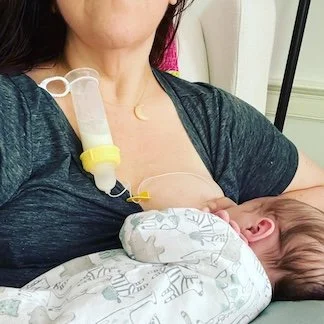
Feeding Ruby at the breast.
Difficult conception, difficult birth, difficult feeding. We settled into a routine with donors. One amazing donor traded milk for Ruby’s hand-me-down clothing and furniture. Another provided us with almost 1,200 ounces. We navigated around caffeine amount, cannabis use, high lipase, prescription medications and the general mystery of receiving milk from people who we didn’t really know. I resigned myself to the fact that all types of supplementation carry some amount of risk, both real and theoretical.
Ruby started sleeping through the night around four months.
I didn’t get the continued stimulation and my cycle returned on the eve of Ruby’s six-month mark. There was so, so much grief and anger at this shift in my body. Holding onto the ability to make milk for my daughter was like trying to hold onto a good dream when your body is waking up.
Ruby weaned before Thanksgiving. From then on, we were at 100% donor milk. I continued pumping, occasionally fortifying her donor bottles with my milk for a bespoke immune boost. I slowly put together two bricks of milk to save for illness.
On February 2nd, a frosty Imbolc morning, I pumped for the last time.
I stashed the three-quarters ounce of milk in my freezer. There it sits still. It was a bittersweet day. It took everything in me not to jump back in the following day.
Ruby was our “one and done”. Until her 13th month of life, Ruby only ever had human milk. All I can say is that I doggedly followed an intuition about what was right for me and my family in the moment.
There is no easy way, there is no best way, but there was my way.
What an accomplishment it felt like to have done it! Much credit was due to the enormous and steadfast community of friends, family, midwives, doulas, and donors. Over 13 months, I connected with more than two dozen donors who gave us more than 10,000 ounces of milk. That’s something like 865 hours of pumping time, or 21.5 full-time work weeks. Such deep and unquestioning generosity has changed me in ways that I’m only beginning to understand.
True to the trope, this midwife did have a tough birth.
Though there was always a community that sustained us in the challenges. Our IVF journey had been funded by donors who contributed to help grow our family, and when heart-wrenching body-failure threatened to knock me off course, again, the community rallied to sustain us. The idea of working to repay that love keeps me going on the hardest of days.
Epilogue:
At just shy of 14 months postpartum, after closing the chapter of our one-and-done baby, the universe laughed. I got pregnant naturally. My supply was sluggish at first. By five months I was producing everything that my second daughter needed.
I wept like a baby when I was able to donate a 52-ounce brick of my own milk to a mom in need. Every time I measure a teaspoon for baking, turning that little bent orange spoon in my hands, I am completely overwhelmed with awe and gratitude.